
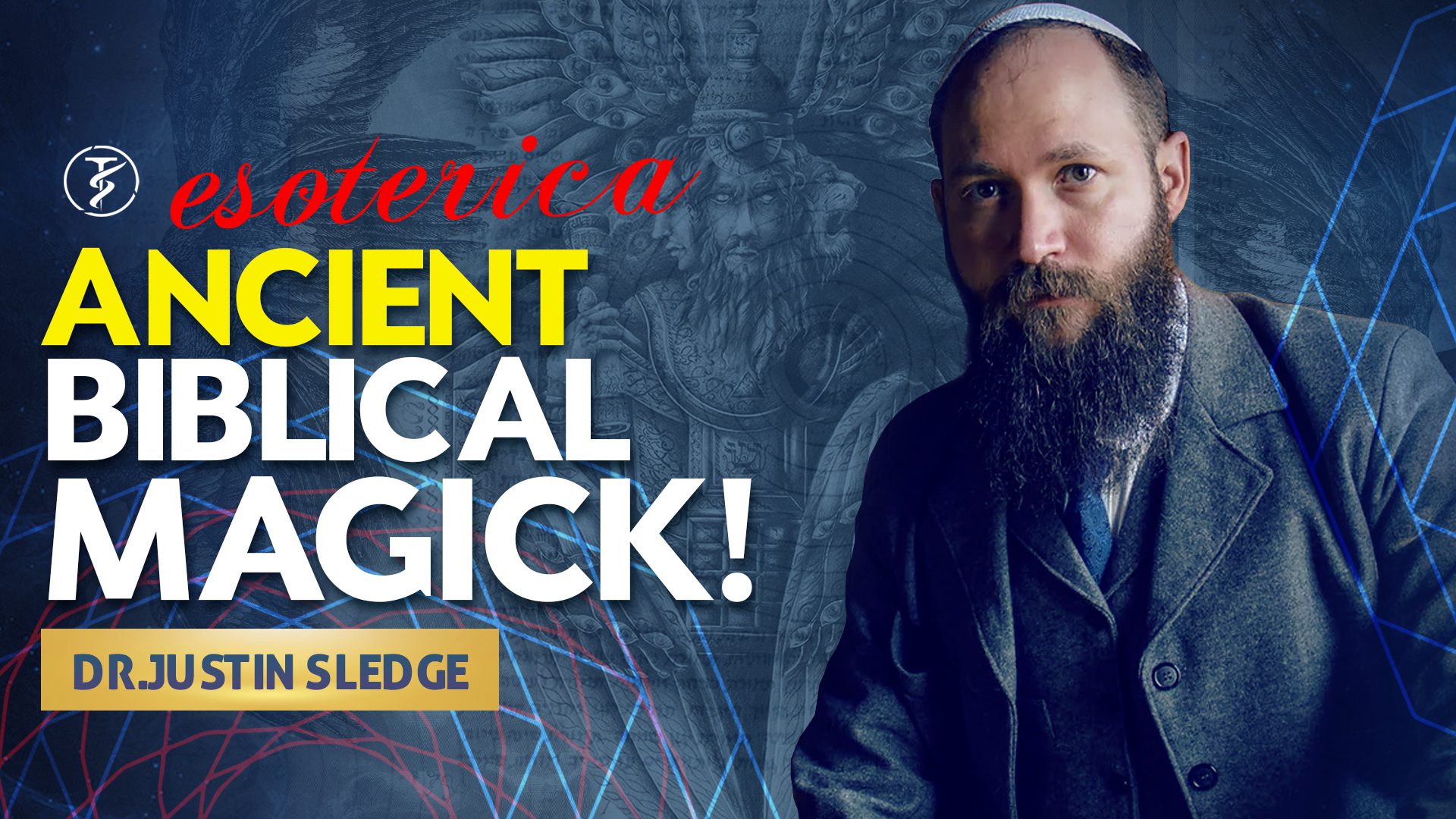
Dr. Justin Sledge on Ancient Biblical Magic, Merkavah Mysticism, and Western Esotericism
Throughout ancient history, mysticism and magic were deeply embedded in the religious practices of the Near East. Academic scholar Dr. Justin Sledge, host of the popular channel ESOTERICA, provides extraordinary research into ancient biblical magic, Western esotericism, and Merkavah mysticism. By inspecting primary manuscripts in their original Hebrew and Greek, we uncover how ancient Near Eastern cultures practiced mysticism and how those traditions shaped the biblical text.
Many modern readers view ancient Scripture through twenty-first-century assumptions. However, when we analyze primary manuscripts through historical scholarship, a fascinating world emerges. Dr. Justin Sledge offers an unbiased, academic perspective on early Jewish mysticism, ancient magical grimoires, and textual history.
Merkavah Mysticism and Paul’s Third Heaven Experience
One of the most intriguing mystical traditions in early Judaism is known as Merkavah mysticism. Rooted in Ezekiel’s vision of the divine chariot, this tradition involved secret techniques used by mystics to enter heavenly palaces. In ancient texts, practitioners were called *Yordei Merkavah*, translating literally as “descenders to the chariot.”
Dr. Justin Sledge highlights a fascinating moment in Second Corinthians chapter twelve. The Apostle Paul writes: “I know a man in Christ who fourteen years ago was caught up to the third heaven.” Paul describes hearing unutterable words that humans are not permitted to speak.
“Paul’s brief reference to the third heaven is like the tip of an iceberg. It reveals that Paul was not an amateur; he was a trained mystic participating in early Jewish Merkavah traditions.”
Dr. Justin Sledge

In *Hekhalot* literature, mystics navigated seven heavenly halls filled with angelic guardians. Paul’s letters offer a rare window into these inner esoteric practices. Consequently, recognizing Paul’s background as a Jewish mystic enriches our understanding of apostolic theology.
Ancient Hebrew Magical Textbooks: Sefer HaRazim and Sefer Yetzirah
In the study of Western esotericism, ancient magical manuscripts preserve essential historical evidence. Dr. Justin Sledge highlights *Sefer HaRazim*, translating as the *Book of Secrets*. Dated to the late Roman period, *Sefer HaRazim* represents the oldest surviving Hebrew magical textbook in the Western world.
This ancient manual details elaborate magical rituals, angelic names, and celestial incantations. According to legend, the angel Raziel handed this book to Noah to navigate pre-flood secrets. Furthermore, another foundational text is *Sefer Yetzirah*, translated by Rabbi Aryeh Kaplan as the *Book of Formation*.

*Sefer Yetzirah* outlines creation through the twenty-two letters of the Hebrew alphabet and ten primordial numbers (*Sefirot*). Dr. Justin Sledge also collects rare historical manuscripts, including 2400 BCE Cuneiform tablets and a 1574 original printing of the *Malleus Maleficarum* (Witch Hunters’ Manual).
Studying these ancient grimoires reveals how magic, religion, and philosophy were deeply intertwined in the ancient Mediterranean world.
The Quilt of Scripture: Textual Layers and Editing
Dr. Justin Sledge compares the construction of the Bible to a complex quilt. Rather than being written seamlessly by a single author, the biblical text consists of distinct historical layers woven together over centuries by multiple scribes.
For example, in original Hebrew, stylistic shifts are immediately apparent. Scribes living in different centuries used contrasting vocabulary, grammar, and idioms. Sledge points to Second Samuel 21:19, which states that Elhanan killed Goliath the Gittite. Later scribal editors in First Chronicles adjusted the narrative to attribute Goliath’s defeat to David.
Likewise, the Flood narrative in Genesis contains layered accounts. In Genesis 6:19, God commands Noah to bring two of every animal onto the ark. However, in Genesis 7:2, the text commands Noah to take seven pairs of clean animals and two pairs of unclean animals.
These parallel accounts demonstrate how ancient editors preserved diverse oral and written traditions alongside one another.
Comparative Ancient Near Eastern Literature
To fully grasp biblical history, we must study the surrounding civilizations of Mesopotamia, Canaan, and Egypt. Ancient Israel was a small nation surrounded by mighty empires. Consequently, Israelite scribes drew heavily upon neighboring literary traditions.
For instance, the Flood story in Genesis shares striking similarities with the *Epic of Gilgamesh* and the *Atrahasis Epic*. In both Mesopotamian accounts, a righteous hero builds an ark, saves animal species, and releases birds to test dry land long before Genesis was composed.

Furthermore, the legal codes in Exodus and Deuteronomy mirror the Hammurabi Code, created a thousand years earlier. Likewise, Proverbs explicitly quotes Egyptian wisdom literature, such as the *Instruction of Amenemope*. Recognizing these parallels does not diminish Scripture; rather, it reveals how ancient authors engaged in cultural dialogue.
Mythological Genesis vs. Historical Judges
From an archaeological perspective, Dr. Justin Sledge distinguishes between mythological primeval narratives and historical Israelite records. He notes that characters like Noah, Methuselah, and Abraham function as foundational theological figures rather than historical individuals.
For example, Methuselah’s 969-year lifespan mirrors the extraordinary lifespans recorded in the Sumerian King List. By contrast, verifiable historical records begin to emerge during the period of the Judges.
The Merneptah Stele, erected in 1208 BCE by Pharaoh Merneptah, contains the oldest extra-biblical inscription mentioning Israel. Sledge notes that historical figures like Deborah, Yael, and Samuel reflect the earliest authentic memories of the Israelite people.
The Evolution of Israelite Religion to Strict Monotheism
Mainstream tradition assumes that Israel practiced strict monotheism from the beginning. However, archaeological discoveries prove that early Israelite religion evolved through distinct stages. Originally, early Israelites practiced henotheism, worshipping Yahweh as their supreme tribal deity while acknowledging lower gods in the divine council.
Ugaritic texts discovered in the 1930s reveal that Yahweh originated outside Canaan, likely in the southern desert regions of Midian and Sinai. Over time, Yahweh absorbed attributes of the Canaanite high god El and the storm god Baal.
Strict radical monotheism emerged during the Babylonian exile. In Third Isaiah chapter 45, God declares: “I form the light, and create darkness: I make peace, create evil: I the Lord do all these things.” Sledge explains that this theological shift moved Yahweh from a localized mountain deity to the universal Creator of the cosmos.
Angels, Magic Prohibitions, and Second Temple Developments
The Old Testament contains explicit prohibitions against magic, sorcery, and necromancy, particularly in Deuteronomy chapter 18. Dr. Justin Sledge points out a simple historical principle: societies do not pass laws against practices nobody is doing. The presence of strict prohibitions proves that ancient Israelites were actively practicing folk magic, divination, and incantations.
Furthermore, angelology underwent a dramatic expansion following the Babylonian exile. Through contact with Persian Zoroastrianism, Judaism developed elaborate angelic hierarchies. Names like Michael, Gabriel, and Raphael appeared for the first time in late Second Temple texts like Daniel and First Enoch.
These spiritual intermediaries helped ordinary believers feel connected to a transcendent God. Understanding this historical background illuminates the rich supernatural landscape of the New Testament.
Jesus as Miracle Worker and Second Moses
In the Gospels, Jesus’ miracles reflect ancient Near Eastern magical and prophetic motifs. Early Christian iconography on third-century Roman catacombs depicts Jesus holding a miracle staff while raising Lazarus and multiplying bread. Sledge notes that early Christians viewed Jesus as the ultimate Second Moses.
Furthermore, the Gospel accounts show an inflation of miraculous details over time. In Mark chapter seven, Jesus heals a blind man using spit and clay applied physically to his eyes. By contrast, in the later Gospel of John, Jesus heals with a spoken word from a distance.
These literary shifts demonstrate how gospel writers presented Jesus as the supreme prophet, fulfilling Messianic expectations through powerful miraculous signs.
Protestant Iconoclasm vs. Sacred Art Preservation
The study of religious history also highlights the impact of the Protestant Reformation on Christian art and mysticism. Sledge laments the widespread iconoclasm carried out by early Protestant reformers across northern Europe.
In their eagerness to reject Catholic ritual, zealots destroyed priceless medieval stained glass, stone sculptures, and sacred art. Sledge compares this artistic destruction to modern religious extremism, such as ISIS destroying ancient Syrian ruins or fanatics demolishing historical monuments.
He stresses that regardless of personal theology, preserving historical art and manuscripts is essential for future generations. Artifacts offer irreplaceable windows into human consciousness.
Academic Skepticism and the Spirit of Thomas
Dr. Justin Sledge approaches Western esotericism with a combination of academic rigor and healthy skepticism. He identifies with Thomas the Apostle, who required empirical evidence before making claims. Sledge refrains from posing as a guru or selling spiritual formulas to his audience.
Instead, his goal is empowering individuals to read primary sources and scholarly literature for themselves. He provides primary book recommendations at the end of every ESOTERICA episode so viewers can do their own heavy lifting.
Understanding the historical development of religion encourages intellectual honesty, critical thinking, and spiritual maturity. Approaching ancient texts with humility allows seekers to appreciate the complex beauty of human spiritual history.
Exploring Ancient Mysticism with Dr. Justin Sledge
Dr. Justin Sledge’s research on ancient biblical magic, Western esotericism, and Merkavah mysticism provides an incredible educational resource for truth seekers. You can explore Dr. Sledge’s video lectures and book recommendations on his official YouTube channel ESOTERICA and website at JustinSledge.com.
To dive deeper into this subject, listen to the full audio conversation on 🎙️ Spreaker, or watch the interview video on 📺 TruthSeekah’s Official YouTube Channel. Explore our podcast archives and spiritual warfare teachings for more deep dives!


